Weave Router vs Nadir
Choose Weave Router when you need inspectable coding routing with Apache-2.0 commercial-use rights. Evaluate task selection, cache rebuilding and escalation in the coding clients you already use, alongside eligible subscriptions. Nadir also supports coding agents; compare its execution paths, savings-share billing and noncommercial self-hosted license with your deployment needs.
[4][5][2]Sources last reviewed
Choose Weave for control over the coding policy and deployment.
Weave combines coding-action selection, cache-aware switching, escalation and supported subscription routing. Nadir offers a decision-only API, a managed proxy and coding-agent integrations, so the choice depends on which execution path and billing model you need.
[4][5]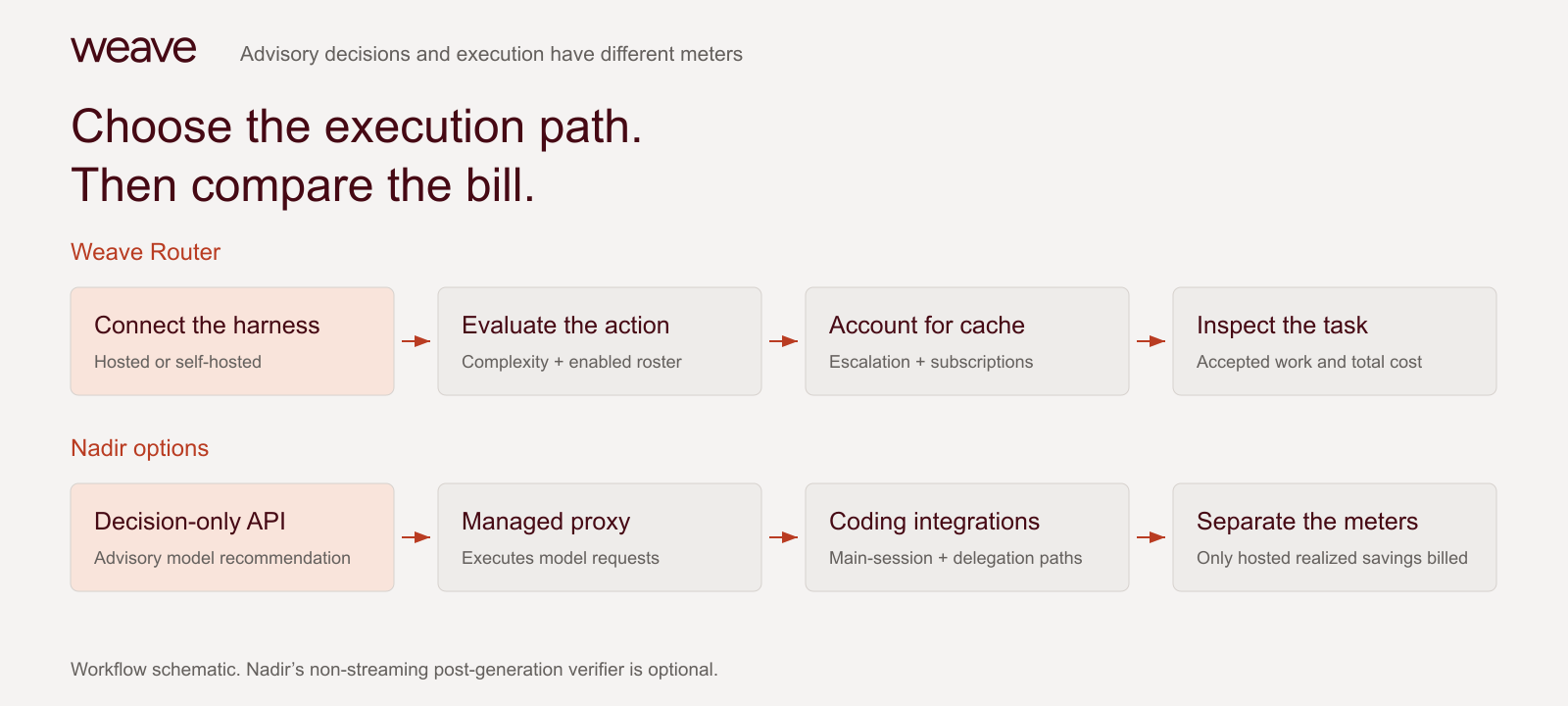
The evidence
Understand Nadir’s fee before comparing headline savings.
This chart applies Nadir’s published hosted Route formula to hypothetical measured monthly gross savings. It shows the platform fee only, not inference cost, projected savings or a Weave price comparison.
Hosted Route fee at three savings levels
USD monthly fee · hypothetical inputs. Bars start at zero.
- $1,000 measured savings
- $250
- $2,000 measured savings
- $500
- $8,000 measured savings
- $1,100
Formula: 25% × min(savings, $2,000) + 10% × max(savings − $2,000, 0). At $8,000 measured savings, the Route fee is $1,100 and retained savings are $6,900. These are fee calculations, not customer outcomes. Decision API and shadow estimates are excluded from savings-share billing.
At a glance
Weave Router and Nadir, compared
Scroll horizontally to see both products on smaller screens.
| Compare | Weave Router | Nadir |
|---|---|---|
| Coding workflow[4][2] | Automatic coding-action selection, cache-aware switching and escalation keep the policy oriented around a complete agent session. | Nadir Auto recommends the main-session model for Claude Code or Codex before each turn. Delegation integrations recommend tiers for subagent work; agent behavior and configuration apply. |
| Decision-only integration[5][2] | Weave’s public API and source support an inspectable integration path; compare that implementation with Nadir’s option to add decision advice beside an existing gateway. | Decision API returns model, effort, cache, context and policy recommendations without a provider call. Shadow estimates are advisory. |
| Verification and escalation[4][2] | Weave documents escalation for coding work; Nadir publishes a classifier for stalling or struggling agents. Compare each trigger and recovery path on the tasks you run. | Managed proxy offers optional post-generation verification for complete non-streaming responses. Streaming bypasses that verifier; uncertain or unavailable routing decisions fall back to the strongest menu model. |
| Cache and subscriptions[4][2] | Accounts for cache rebuild economics and supports eligible existing Claude/Codex subscriptions, so teams can assess context costs and current plan capacity together. | Documents cache recommendations and a Claude plugin main-model switch when its cache check favors Haiku. Coding-agent inference uses the developer’s provider account. |
| Pricing[7][6][2] | Code Max is $10/month with $50 in monthly credits for open-source models. Code Boost is $100/month with $200 in monthly credits and access to OpenAI, Anthropic and open-source models. Router subscriptions are separate from platform plans; enterprise deployment is custom. Confirm the applicable quota, provider charges and deployment terms. | Hosted Route has no base fee: 25% of the first $2,000 measured monthly savings, then 10% above it. Decision API and shadow estimates never enter savings-share billing. Lens seats are a separate product meter. |
| Self-hosted license[5][2] | Apache-2.0 source allows commercial use and self-hosting, subject to deployment and support terms; NadirClaw’s core uses PolyForm Noncommercial. | NadirClaw uses PolyForm Noncommercial. Nadir calls it source-available, not open source. Review commercial-use rights for your deployment. |
| Performance evidence[13][2][3] | A published Codex benchmark harness on Terminal-Bench and SWE-Atlas gives teams a reproducible starting point; it is not a matched Weave-versus-Nadir result. | Publishes multiple evaluations with different task pools and verification assumptions. They are not matched Weave comparisons. |
Sources and comparison method
Published by Weave. Vendor documentation and prices reviewed October 17, 2026. Recommendations reflect workflow fit. Product tiers and integration coverage vary. Performance charts retain the scope and limitations of the cited experiments.
- Nadir: decision API, proxy and coding workflow
- Nadir pricing: measured savings share and product meters
- Nadir FAQ: streaming verification, evaluation scope and licensing
- Weave Router: workflow, cache decisions and escalation
- Weave Router: public source and installation
- Code Boost: $100/month and $200 monthly credits
- Weave platform and separately billed Router plans
- Silk 1: explained code output and calibration
- Token Intelligence: AI attribution and cost sources
- Engineering Intelligence: quality, reviews and delivery
- Weave AI ROI: units, coverage and limits
- Published Router 2.0 coding benchmark results and run notes
- Reproducible Codex benchmark harness
What is Weave Router?
Weave Router routes individual coding-agent actions using task complexity, cache economics, escalation and eligible provider subscriptions. Its public installer supports Claude Code, Codex, OpenCode and Pi; the public repository also documents Cursor in early beta. Hosted plans and self-hosted deployment are separate options.
[4][5]What is Nadir?
Nadir is a task-based LLM router. Its decision API can recommend a model without making the provider call; its managed proxy executes a route. It also documents a main-session launcher and delegation integrations for coding agents. Hosted Route uses measured-savings pricing. NadirClaw is a distinct self-hosted, source-available core.
[1][2][3]The key difference
One coding policy, or a decision layer beside your gateway?
Nadir: choose how much of execution to hand over
Nadir’s decision API can sit alongside a gateway you already operate; its managed proxy can execute requests; coding-agent integrations introduce another path. Its public pricing carefully separates projected savings from realized hosted savings. Choose the path before comparing features or fees.
Weave: run and inspect a coding workflow
Weave is a strong choice when you want model selection, session cache economics, escalation and supported subscriptions together. Its Apache-2.0 source and documented coding harness give platform teams an implementation and evaluation path they can inspect.
Choose Weave when you want to inspect and operate a coding-session policy under Apache-2.0 commercial-use terms. Match the execution paths in your trial, including streaming, failure recovery and the quality checks that actually run.
Why teams choose Weave
Control the workflow and understand the commercial model.
Inspect the full coding session
Weave’s documented policy considers task selection, cache rebuilding and escalation together. Test those decisions on a full coding task so a cheaper request does not become your only measure of value.
[4]Keep control of the workflow and its cost basis
Operate with commercial-use rights
Weave Router
Weave’s Apache-2.0 source lets your team inspect and self-host the routing implementation for commercial use. Choose that path when deployment control and license permissions matter to the rollout.
Nadir
NadirClaw’s self-hosted core uses PolyForm Noncommercial; hosted API and proxy offers have separate terms. Match the license and execution path to your intended commercial deployment.
Inspect decisions across a coding session
Weave Router
Weave considers cache rebuilding and escalation during multi-action coding work. Trace those decisions on a streaming task to assess the complete workflow rather than a standalone model recommendation.
Nadir
Check the coding-agent integration or proxy path you choose. Streaming proxy responses bypass post-generation verification.
Budget with the correct cost basis
Weave Router
Weave publishes hosted offers and supports eligible provider subscriptions. Reconcile plan charges, credits and provider usage, then use the separate intelligence platform when you need engineering-output context for the budget.
Nadir
Reconcile the declared baseline and executed hosted savings ledger. Do not bill advisory shadow estimates as realized savings.
When Nadir is the better fit
Nadir is worth evaluating if you want shadow-mode recommendations beside an existing gateway or prefer a hosted fee tied to measured savings. It also supports coding agents. Its optional verifier has a specific non-streaming scope; test the actual path you plan to use. No matched result establishes that either product is universally cheaper. Choose Weave when commercial-use licensing and an inspectable coding-session policy carry more weight.
[2][5][4]How to evaluate switching from Nadir
Keep a working baseline
Save your current endpoint and client configuration. Pick representative tasks with tests, review criteria and a known working pinned model.
Connect one coding harness
Run npx @weave-os/router and choose your supported harness. Select the plan, enabled models and credentials appropriate to that deployment. Start a fresh session after configuration.
Measure completed work
Compare accepted changes, full-session cost, cache reads and writes, retries and elapsed time. Include any subscription and platform fees; a lower token price is not enough.
Expand after review
Roll out to a small group after checking streaming, tool use and model-specific behavior. Keep a direct route for rollback and use model pinning for work that requires it.