Weave Router vs Martian
Keep Claude Code or Codex and make model selection a policy you can inspect. Weave Router documents task-aware selection, cache-aware switching, escalation and eligible subscription routing, with public source and a coding evaluation harness. Martian supports these coding clients too; compare the policy you need with its current Gateway offering.
[6][7][2]Sources last reviewed
Choose Weave to inspect how each coding action gets its model.
Martian supports Claude Code and Codex through its Gateway. The distinction is the routing decision you are buying: Weave documents complexity-based selection, cache-aware switching, escalation and subscription routing. Martian’s current public setup guides emphasize gateway access and named-model configuration.
[6][7]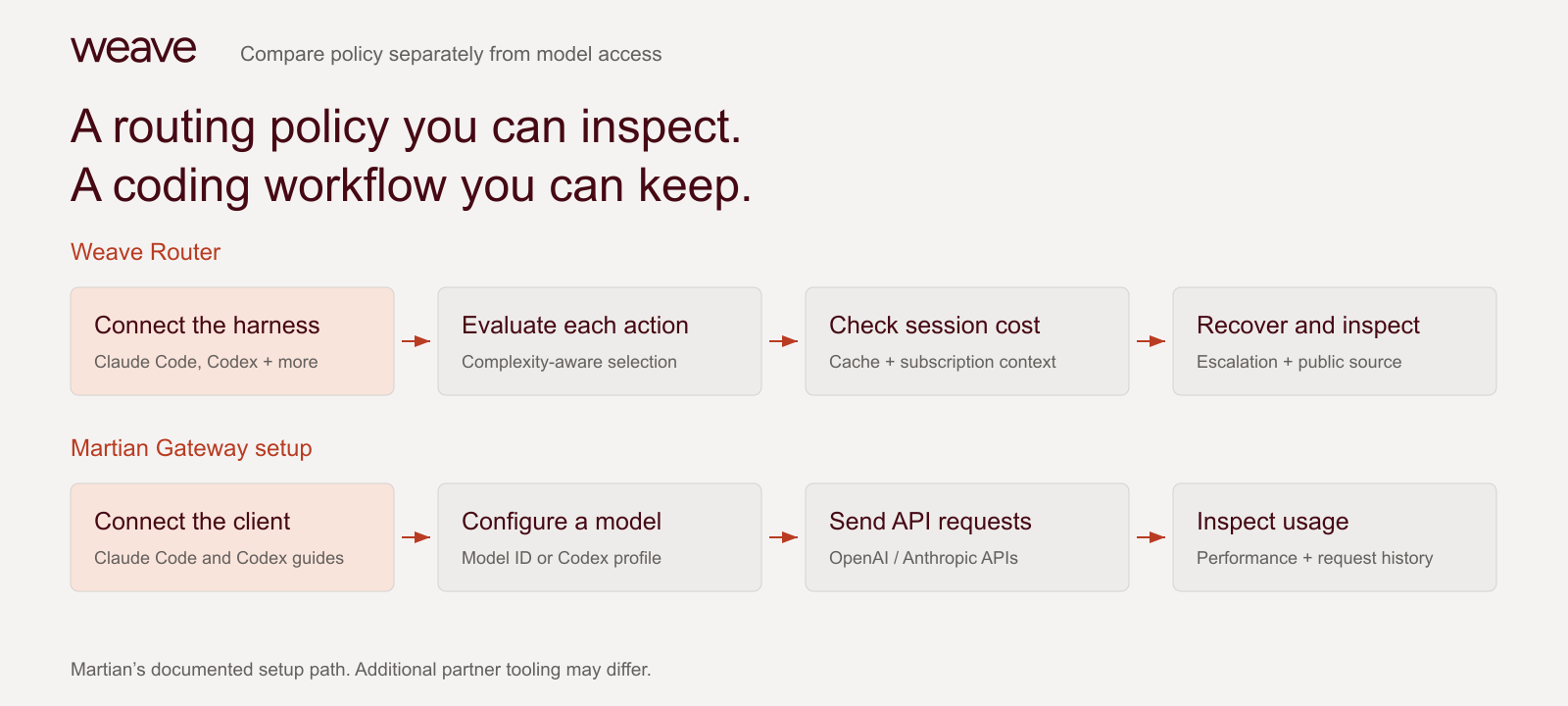
At a glance
Weave Router and Martian, compared
Scroll horizontally to see both products on smaller screens.
| Compare | Weave Router | Martian |
|---|---|---|
| Coding clients[7][3][4] | Installer for Claude Code, Codex, OpenCode and Pi; Cursor is documented in early beta. Teams can evaluate the routing policy inside their existing terminal workflow. | Explicit Claude Code CLI and Codex guides, with additional integrations in its docs navigation. |
| Documented model choice[6][3][4] | Complexity-aware routing, cache-aware switching and escalation for coding actions, so model choice can respond to the work as a task changes. | Claude Code supports a configured model ID; Codex uses model-specific profiles. Confirm any automatic policy in the product and plan offered to you. |
| Model access[7][8][2] | An enabled provider roster with hosted plan limits or self-hosted configuration; Martian advertises a broader 200+ model Gateway catalog, while Weave makes coding policy and deployment inspectable. | Gateway advertises 200+ models and compatibility with OpenAI and Anthropic APIs. |
| Existing subscriptions[6][3][4] | Documents routing across eligible Claude and Codex subscriptions, giving teams a way to compare existing plan capacity with Gateway credit and API costs. | Integration guides use a Martian API key and Gateway credits. That setup is a different meter from flat-rate coding subscriptions. |
| Operational evidence[7][15][2] | Public Router source, OTLP traces and a reproducible Codex benchmark harness; teams can inspect the implementation and test completed coding tasks alongside Gateway usage data. | Gateway documentation describes real-time usage, model performance and request history in its dashboard. |
| Pricing and availability[9][8][5][3] | Code Max is $10/month with $50 in monthly credits for open-source models. Code Boost is $100/month with $200 in monthly credits and access to OpenAI, Anthropic and open-source models. Router subscriptions are separate from platform plans; enterprise deployment is custom. Confirm the applicable quota, provider charges and deployment terms. | Current guides require a Martian API key and direct users to the dashboard and available models. A current automatic-router fee and commercial service commitment were not established from these public pages. Confirm the exact offer; do not use an old announcement as a quote. |
| Research tooling[15][5] | Use Weave’s published harness to compare task completion, cost and time on coding work; Martian’s ARES and K-Steering tools serve different research and steering needs. | ARES and K-Steering are separate research tools. Their availability does not establish a commercial Gateway routing result. |
Sources and comparison method
Published by Weave. Vendor documentation and prices reviewed October 17, 2026. Recommendations reflect workflow fit. Product tiers and integration coverage vary. Performance charts retain the scope and limitations of the cited experiments.
- Martian: current research lab and product context
- Martian Gateway: model access, APIs and usage history
- Martian Claude Code CLI integration
- Martian Codex integration and model profiles
- Martian documentation: Gateway, ARES and K-Steering
- Weave Router: workflow, cache decisions and escalation
- Weave Router: public source and installation
- Code Boost: $100/month and $200 monthly credits
- Weave platform and separately billed Router plans
- Silk 1: explained code output and calibration
- Token Intelligence: AI attribution and cost sources
- Engineering Intelligence: quality, reviews and delivery
- Weave AI ROI: units, coverage and limits
- Published Router 2.0 coding benchmark results and run notes
- Reproducible Codex benchmark harness
What is Weave Router?
Weave Router routes individual coding-agent actions using task complexity, cache economics, escalation and eligible provider subscriptions. Its public installer supports Claude Code, Codex, OpenCode and Pi; the public repository also documents Cursor in early beta. Hosted plans and self-hosted deployment are separate options.
[6][7]What is Martian?
Martian currently describes itself as an AI research lab. Its public tools include a Gateway for more than 200 models, ARES for training and evaluating agents, and K-Steering for inference-time steering. The Gateway supports OpenAI and Anthropic APIs and documents Claude Code and Codex configuration. Historical model-router coverage should not substitute for the terms of the current product.
[5][2][3][4]The key difference
Buy the routing behavior, then evaluate the gateway.
Martian documents a capable gateway
Its current guides show how to connect Claude Code and Codex, choose model IDs and view request history. Additional partner tooling is mentioned in its documentation. Establish the exact routing product, default policy, support and pricing before comparing an older Martian router story with a current Weave deployment.
Weave makes the coding policy explicit
Weave publishes what its coding router considers: action difficulty, cache tradeoffs, escalation and subscription quota. You can inspect the open-source implementation and reproduce the published Codex evaluation. This gives a team a concrete policy to test before rollout.
Choose Weave when you want automatic coding-action selection with a public implementation, documented cache and escalation behavior, and a reproducible evaluation path.
Why teams choose Weave
A concrete path from installation to evaluation.
Know what you are evaluating
Read Weave’s public implementation and documented selection policy before committing to a rollout. Test cache decisions and escalation on multi-step work so the purchase is grounded in observable routing behavior.
[6][7]Keep your coding workflow
Weave documents setup for the terminal coding clients your team already uses. Evaluate routing against your existing task and acceptance criteria, with the same harness, before expanding the rollout.
[7]Make the coding policy visible before rollout
Automate coding-action selection
Weave Router
Weave selects models by coding-action difficulty, with model pinning for exceptions. Inspect the selection policy instead of making every routine action a manual model-choice decision.
Martian
Review the named-model integration examples and request a specification for any automatic policy included in your offer.
Inspect the response to harder work
Weave Router
Weave documents cache-aware switching and escalation. Follow those decisions as a task moves from exploration to implementation so the team can assess session cost and recovery behavior together.
Martian
Use Gateway request history to review the served model, then verify any configured switching and fallback behavior.
Reproduce the coding evaluation
Weave Router
Weave publishes its Codex benchmark harness. Use that reproducible starting point to test task completion, cost and time against your own acceptance criteria before expanding a rollout.
Martian
Separate research framework results, Gateway telemetry and any commercial routing claims. They answer different questions.
When Martian is the better fit
Evaluate Martian when you want its unified Gateway model access, are already using its integrations, or need ARES or K-Steering for research. If a partner offer includes automatic routing, compare its current specification and service terms directly. No matched Weave-versus-Martian performance experiment is claimed here. Choose Weave when its inspectable coding policy and reproduction path address your decision.
[5][2][6][15]How to evaluate Weave alongside Martian
Keep a working baseline
Save your current endpoint and client configuration. Pick representative tasks with tests, review criteria and a known working pinned model.
Connect one coding harness
Run npx @weave-os/router and choose your supported harness. Select the plan, enabled models and credentials appropriate to that deployment. Start a fresh session after configuration.
Measure completed work
Compare accepted changes, full-session cost, cache reads and writes, retries and elapsed time. Include any subscription and platform fees; a lower token price is not enough.
Expand after review
Roll out to a small group after checking streaming, tool use and model-specific behavior. Keep a direct route for rollback and use model pinning for work that requires it.