Weave vs Swarmia: which engineering intelligence platform fits your team?
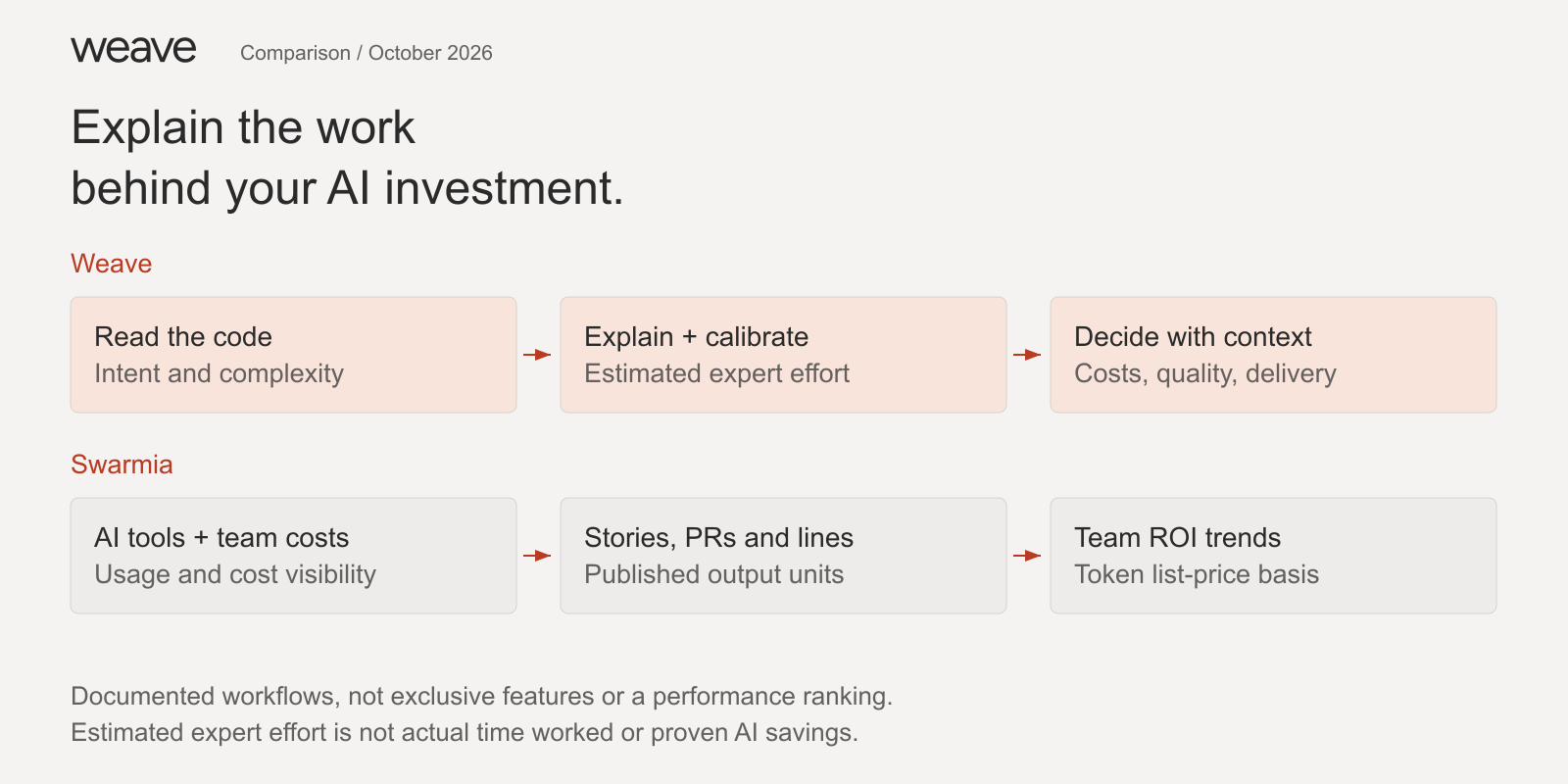
Choose Weave when your AI budget needs an explanation of the work inside each code change. Silk 1 estimates expert effort and explains its reasoning, with calibration from your team. Swarmia reports AI economics using stories, PRs and lines changed. Weave gives engineers an explained output unit to bring to that discussion.
Sources last reviewed
The short version
Put an explained output unit beside your AI spending.
A story, a merged PR and a line changed are different units. Swarmia’s ROI view reports costs against each. Weave estimates the expert effort represented by the code, explains the reasoning and supports team calibration. That gives engineers a way to discuss changes in work complexity alongside labeled AI costs, quality and delivery. Expert effort is an estimate, not actual time worked or proven AI savings.
At a glance
How Weave and Swarmia compare
Scroll horizontally to see both products on smaller screens.
| Compare | Weave | Swarmia |
|---|---|---|
| Explain the work behind the output[1][3][8][9] | Silk 1 estimates expert effort from code changes, explains its reasoning and supports team calibration. Engineers can inspect what the output measure represents. | Swarmia’s August 7 ROI release defines output as stories or epics, merged PRs and lines changed. It uses AI token list prices and an administrator-set developer cost. These are documented economic measures; their units and cost assumptions differ from an estimate of expert effort. |
| AI adoption[2][8] | AI usage and assisted output by team, tool, and individual where supported. | Usage and cost by person and team for supported coding tools. |
| Cost measurement[2][7][9][3] | Labels provider-billed costs, modeled usage and configured subscription allocations. Inspect coverage before using the total in a renewal decision. | Seat and usage cost visibility; the ROI view uses token list prices and configured developer cost. |
| Quality and delivery[1][7] | Output analysis read alongside code review, quality, and delivery signals. | Delivery metrics, developer feedback, and working agreements for team improvement. |
| Limits to validate[2][9] | Confirm tool-level cost coverage. A code output score is an estimate, not realized business value or proof of causality. | Its ROI release defines AI cost using token list prices. Reconcile that basis with actual invoices and keep quality signals beside throughput. |
| Investigate the investment question[5][7] | Wooly answers engineering questions with links to underlying organizational records. Use the evidence to investigate a change in output, quality or cost. | Team metrics, developer feedback and working agreements support an ongoing improvement process. |
Sources and comparison method
Published by Weave. First-party product and methodology pages reviewed October 16, 2026. This documentation comparison describes the sourced methods and buyer fit; it is not an independent product trial or proof of exclusive capabilities. No matched accuracy, savings or ROI benchmark was run. Confirm connector coverage, reporting and commercial terms in a trial.
- Weave Code Intelligence: explained effort estimates and team calibration
- Weave Token Intelligence: cost sources, attribution and agents
- Weave AI ROI methodology: output units, coverage and limits
- Weave Engineering Intelligence: quality, delivery and investment context
- Wooly: answers linked to underlying engineering records
- Weave Router: separately offered coding-agent routing
- Swarmia product overview
- Swarmia AI adoption and cost
- Swarmia AI ROI release and calculation
What is Weave?
Weave combines Code Intelligence, Token Intelligence, Engineering Intelligence and Wooly. Silk 1 explains estimated expert effort in code changes and supports team calibration. Labeled costs, attribution coverage, quality and delivery help you investigate what an AI investment supported. Weave Router is a separately offered product for coding-agent model routing.
What is Swarmia?
Swarmia combines engineering metrics, developer surveys, working agreements, and AI measurements. Its AI cost views include person and team breakdowns, while its ROI view reports team throughput and cost per unit.
The key difference
Explain the work inside the cost-per-unit figure
Swarmia’s documented approach
Swarmia’s August 7 ROI release defines output as stories or epics, merged PRs and lines changed. It uses AI token list prices and an administrator-set developer cost. These are documented economic measures; their units and cost assumptions differ from an estimate of expert effort.
Weave explains the code behind the estimate
Silk 1 reads intent, complexity, risk and dependencies in code changes, estimates expert effort and explains its reasoning. Engineers can inspect and calibrate the score. Put that output beside labeled AI costs, attribution coverage and quality so the budget discussion has an explanation of the work behind it.
Choose Weave when your decision needs this code-level explanation. Compare the same team and period, with review and rework in view. Estimated expert hours describe modeled effort; they are not actual hours worked, payroll savings or proof that AI caused a gain.
Why choose Weave
Bring the work behind the numbers to your budget decision
Explain the work inside each change
Silk 1 reads code changes and explains its expert-effort estimate. Team calibration gives engineers a way to challenge the reasoning before it becomes part of an investment discussion.
[1][3]How Weave helps you make the investment decision
Compare a routine fix with a refactor
Weave
Read the reasoning behind each effort estimate and calibrate it with engineers who know the code. Your discussion can account for what the work involves, rather than treating every merged change as the same unit.
Swarmia
Swarmia’s ROI view reports cost per story or epic, merged PR and line changed. Its release explicitly notes that rising PR size can change the interpretation of those trends.
Explain the cost basis to finance
Weave
Cost-source labels distinguish provider billing, modeled usage and configured subscription allocations. Review the supported tool coverage and show unassigned costs before discussing cost efficiency.
Swarmia
Swarmia’s published ROI calculation uses token list prices and a configured average developer cost. Its separate cost product also provides person and team visibility. Do not treat those ROI assumptions as a universal statement about every Swarmia cost report.
When Swarmia may be the better fit
Swarmia is a strong candidate when working agreements, developer surveys and team delivery improvement lead your requirements. Choose Weave when your investment decision needs an explained, team-calibrated measure of the code itself, with labeled AI cost sources and quality context.
[7][9][1][3]Evaluate Weave with your own work
Bring a real investment question
Choose the tool renewal, team rollout or budget question you need to answer. Select representative code changes and a consistent reporting period.
Inspect the output and its evidence
In Weave, read the effort estimate and reasoning. Ask engineers to review calibration, then check cost-source labels, attribution coverage, identity mapping and data permissions.
Decide with quality and delivery in view
Compare the result with review effort, rework and delivery. Keep unsupported costs and missing signals visible. Confirm required integrations, exports and commercial terms before switching.
Inspect the evidence
- Weave Code Intelligence: explained effort estimates and team calibration
- Weave Token Intelligence: cost sources, attribution and agents
- Weave AI ROI methodology: output units, coverage and limits
- Weave Engineering Intelligence: quality, delivery and investment context
- Wooly: answers linked to underlying engineering records
- Weave Router: separately offered coding-agent routing
Frequently asked questions
Compare engineering intelligence
All comparisonsSee what your AI budget supported
Bring a real PR and a renewal question. See Silk 1’s reasoning, explore team calibration and inspect the cost and quality context in Weave.