Weave vs Larridin
Choose Weave when engineers need to explain and calibrate the work represented by an output score. Silk 1 estimates expert effort from source changes; labeled AI costs, quality and delivery provide context for the investment. Larridin also measures output and spend and offers routing. Compare the output units and the evidence you can inspect behind each result.
[10][13][1]Sources last reviewed
The short version
Choose Weave for output reasoning your engineers can inspect.
Both products connect engineering output, AI spend, quality and coding workflows. Weave’s case rests on Silk 1’s expert-effort estimates, explanations and team calibration, cost-source clarity, and the public Apache-2.0 Router with a reproducible coding benchmark harness.
[10][13][11]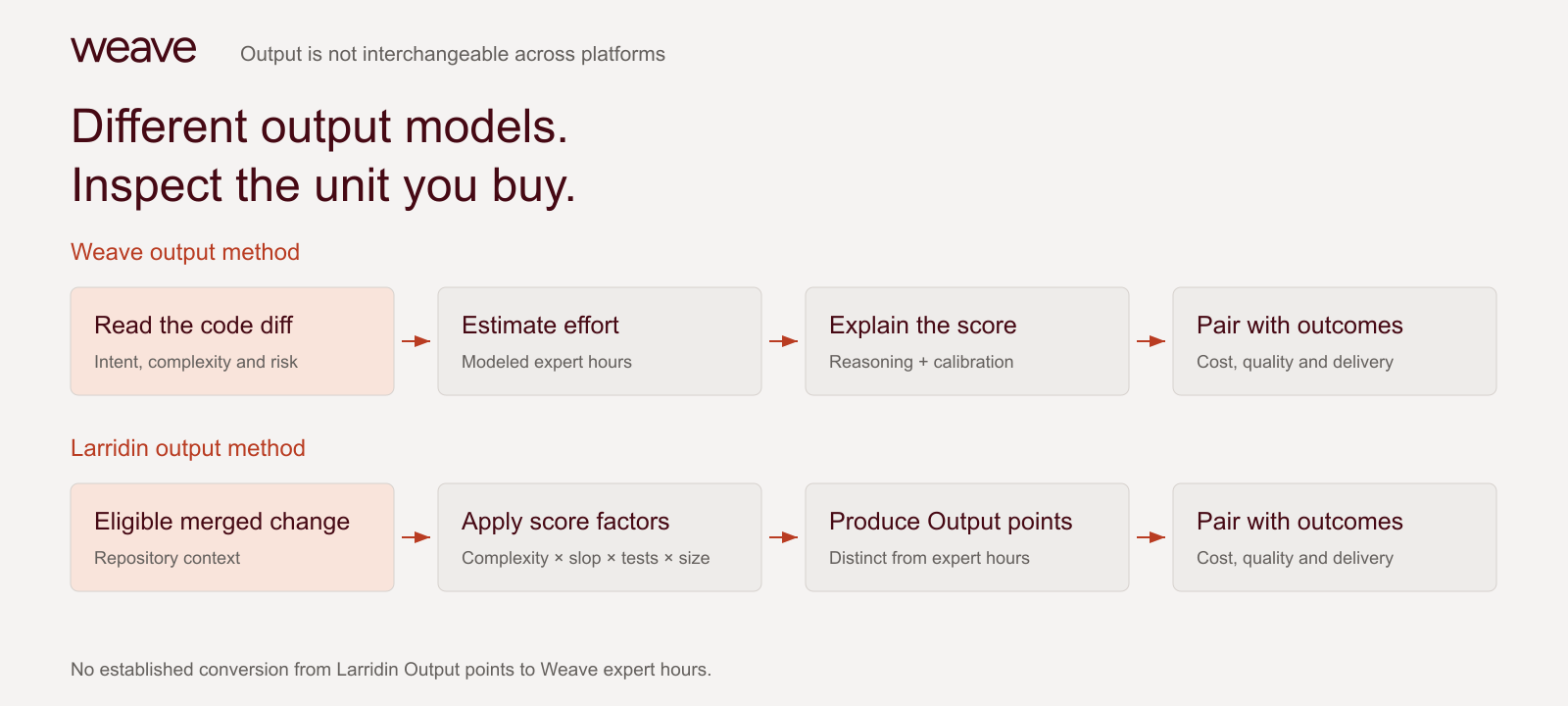
At a glance
Weave and Larridin, compared
Scroll horizontally to see both products on smaller screens.
| Compare | Weave | Larridin |
|---|---|---|
| Engineering scope[13][1][4] | Code, Token and Engineering Intelligence connect output, spend, quality and delivery, giving finance and engineering shared context for investment decisions. | Developer Intelligence combines output, AI spend, quality, agent effectiveness/readiness and delivery; broader AI intelligence serves other company workflows. |
| Output unit[10][13][2] | Estimated expert hours from code analysis, with plain-language reasoning and team calibration so engineers can inspect what the score represents. | Output points: complexity weight × slop factor × test factor × bounded size factor, on eligible merged changes. |
| Quality in the score[12][13][2] | Read output beside separate quality, turnover, review, revert and delivery measures to keep work-volume interpretation connected to what shipped. | The current formula includes test and slop factors; later rework, incidents and reliability are separate outcomes, not direct discounts in that formula. |
| AI tool cost coverage[11][13][1] | Per-engineer cost sources include Claude Code, Cursor, GitHub Copilot, Codex, OpenAI API, Devin and Windsurf. Distinct labels for billing, modeled usage and allocated seats help teams explain coverage across a mixed tool stack; detail varies by integration. | Evaluate the integrations and cost definitions included in your plan against the same tool roster and billing period. |
| AI attribution and economics[11][13][2] | Labels native, metadata and estimated evidence; fidelity separates billing, modeled usage and seat allocations so teams can explain which cost evidence is behind a ratio. | Distinguishes line-weighted AI Code Share, AI Output Share and AI PR Share. Its method explains output per $1K and separate ROI assumptions. |
| Coding router[7][6][15][3] | Apache-2.0 public source, documented cache-aware routing, escalation and eligible subscriptions, plus a Codex benchmark harness teams can inspect before testing their own policy. | Advertises task-based model selection, policy controls, caching visibility and model pinning. Product examples are illustrative. |
| Assistant and agent workflows[12][9][1][2] | Wooly supports engineering-data investigation; Router and intelligence products have separate purposes and billing, so teams can scope each decision to the product they need. | Agent Effectiveness, Agent Readiness and Ask AI/MCP are part of the developer offer; MCP is described as beta and role-scoped. |
| Pricing[9][5] | Starter is $0. Pro is $50 per engineer per month on monthly billing; the pricing page displays $42 per engineer per month with annual billing. Enterprise is quoted. Router and add-ons are separately priced; use the feature tier and contract terms that match your evaluation. | Public contact flow requests organization-specific pricing. A fixed list rate or minimum contract was not established from these pages. Confirm module, integration, routing and support scope in the quote. |
Sources and comparison method
Published by Weave. Vendor documentation and prices reviewed October 17, 2026. Recommendations reflect workflow fit. Product tiers and integration coverage vary. Performance charts retain the scope and limitations of the cited experiments.
- Larridin Developer Intelligence: output, spend, quality and agents
- Larridin methodology: Output formula, units and illustrative examples
- Larridin Router: policy, model controls and illustrative impact
- Larridin: company-wide AI adoption and intelligence
- Larridin: request organization-specific pricing
- Weave Router: workflow, cache decisions and escalation
- Weave Router: public source and installation
- Code Boost: $100/month and $200 monthly credits
- Weave platform and separately billed Router plans
- Silk 1: explained code output and calibration
- Token Intelligence: AI attribution and cost sources
- Engineering Intelligence: quality, reviews and delivery
- Weave AI ROI: units, coverage and limits
- Published Router 2.0 coding benchmark results and run notes
- Reproducible Codex benchmark harness
What is Weave?
Weave connects Code Intelligence, Token Intelligence and Engineering Intelligence. Silk 1 reads code diffs and estimates expert effort with explanations and team calibration. Teams can inspect that output beside AI attribution, cost sources, quality, reviews and delivery, and use Wooly to investigate their engineering data. Router is a separately billed product for improving model selection.
[10][11][12][13][6]What is Larridin?
Larridin offers company-wide AI adoption and intelligence alongside Developer Intelligence. Its engineering offer covers complexity-adjusted output, output per dollar, quality, agent effectiveness and readiness, delivery, spend and model routing. Its public methodology defines scoring formulas, attribution denominators and illustrative examples.
[4][1][2][3]The key difference
The output unit is a buying decision.
Larridin: score eligible merged work in points
Its current formula multiplies a complexity weight by slop, test and size factors. It publishes how those components work, including a changed-lines factor that approaches one as a change grows. This is a different output model. A points-per-dollar ratio cannot be compared numerically with Weave’s expert-hours-per-dollar ratio.
Weave: explain the expert effort represented
Silk 1 reads the code diff and estimates expert effort with plain-language reasoning and organization-aware calibration. Teams can inspect why a complex change receives its score and compare that modeled output with attributed AI spend. Weave’s methodology explicitly separates this unit from hours worked, hours saved and business value.
Choose Weave when expert-effort explanations, team calibration and an inspectable routing implementation fit your engineering decisions. Evaluate both systems on the same familiar changes, then keep their units and assumptions distinct.
Why teams choose Weave
Explain the code. Inspect the cost. Reproduce the routing.
Discuss the work behind the score
Silk 1 analyzes source changes and explains its estimate of expert effort. Your engineers can inspect the reasoning and calibrate the estimate to the team’s context before using it in an investment discussion.
[10][13]Defend the calculation with its coverage
Weave labels attribution strength and cost-source fidelity, then defines what cost per estimated expert hour represents. Explain which spending and output are included before comparing teams or renewing a tool.
[13][11]Inspect and test the separate Router
Weave’s Apache-2.0 Router and public Codex benchmark harness let you inspect the implementation and design a coding evaluation. Router plans are separate from the intelligence platform; test task completion, cost and time before choosing a routing setup.
[7][15][6][9]Explain the score before defending the investment
Explain the work behind a score
Weave
Silk 1 explains its expert-effort estimate against the full code diff and supports team calibration. Give engineers a way to discuss the reasoning behind the output unit used in a budget decision.
Larridin
Inspect complexity, slop, test and size factors for the same eligible merged change. Do not convert points into hours.
Defend the cost calculation
Weave
Weave labels cost sources and attribution strength and defines cost per estimated expert hour. Explain what spending and output the ratio covers, using the same cohort, repositories and time window.
Larridin
Match its complete-week denominators, attributed added lines and Output points. Keep ROI capacity assumptions separate from points.
Inspect and reproduce model routing
Weave
Weave publishes its Apache-2.0 Router and Codex evaluation harness. Inspect the implementation and test task completion, cost and time on your work before committing to a routing policy.
Larridin
Test the policy enabled in your organization. The public routing dashboards label their numbers as illustrative, not customer results.
Keep the engineering investment in context
Weave
Weave’s Code, Token and Engineering Intelligence connect output, quality, spend and delivery. Keep those measures together when investigating an engineering investment, with the product tiers and coverage your team needs.
Larridin
Evaluate developer modules and broader company AI adoption/fluency scope against the actual quote.
When Larridin is the better fit
Larridin can be the better fit when the purchase combines company-wide AI adoption, fluency and workflow intelligence with its developer offering, or when its published points model and readiness assessment fit your program. Both products advertise output, spend and routing. No matched benchmark establishes a universal winner across those capabilities. Choose Weave when explained expert-effort estimates and team calibration fit the decision you need to make.
[4][1][2][10][13]How to evaluate switching from Larridin
Match the scope
Select the same repositories, teams and complete time windows in both platforms. Include refactors, features and maintenance work in your review set.
Inspect the underlying changes
Connect source control and the relevant project tools. Have engineers review familiar PRs and compare score explanations with their own judgment.
Reconcile AI evidence and billing
Connect supported AI tool sources. Separate native telemetry, commit metadata and activity-based estimates, then reconcile provider charges and allocated seats without double counting.
Review outcomes before replacing reports
Compare review load, rework, reverts and delivery beside cost per output. Keep your existing reports until data coverage, permissions and finance definitions have been agreed.