Weave vs Allstacks
Explain the engineering work behind your AI investment with Weave. Silk 1 estimates expert effort from code changes, explains its reasoning and supports team calibration. Read that output beside labeled AI costs, quality and delivery when discussing a renewal or expansion. Allstacks also measures AI impact, with a strong focus on initiative forecasts and delivery risk.
[7][8][9][1]Sources last reviewed
The short version
Choose Weave to explain the work behind the AI budget.
Weave starts with the code change: Silk 1 estimates expert effort, explains the score and supports team calibration. Token and Engineering Intelligence put that output beside attribution, costs, quality and delivery. Allstacks is a strong alternative when initiative forecasts and delivery-risk investigation drive the purchase.
[7][10][8]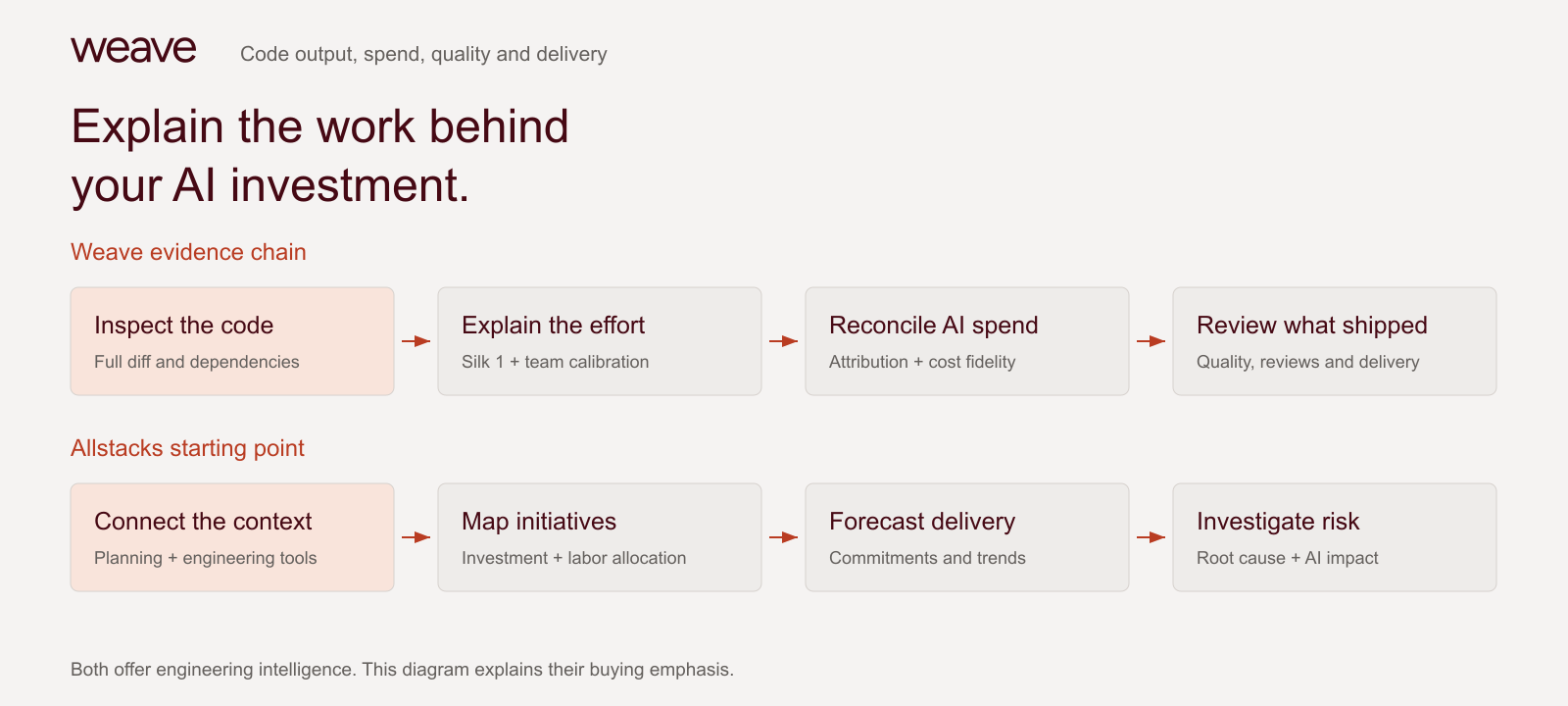
The evidence
Published pricing, with the commitment visible.
These bars normalize published list rates to one contributor or engineer over 12 months. Both Weave Pro billing options are shown. Feature scope, billable-person definitions and commitments differ.
12-month list-rate basis per person
USD · product scope and contracts differ. Bars start at zero.
- Weave Pro · monthly × 12
- $600
- Weave Pro · annual displayed rate
- ≈$504
- Allstacks Growth · annual
- $400
- Allstacks Enterprise · annual
- $600
Weave Pro monthly: $50 × 12 = $600 per engineer. The displayed annual-billing equivalent is $42/month (approximately $504 over 12 months using the rounded displayed rate; confirm the annual invoice). Allstacks Growth: $400/contributor/year. Enterprise: $600/contributor/year with at least 100 contributors, or $60,000/year at that minimum before add-ons or discounts. Allstacks requires annual terms. Free Product Studio and $200/contributor/year capitalization are separate offers.
At a glance
Weave and Allstacks, compared
Scroll horizontally to see both products on smaller screens.
| Compare | Weave | Allstacks |
|---|---|---|
| Starting point[7][10][1] | Source-code analysis and explained expert-effort output, connected to AI cost, quality and delivery, so finance and engineering can inspect what the investment produced. | Connected planning and delivery context, forecasts, risk investigation and investment intelligence. |
| Work normalization[7][1] | Silk 1 reads full diffs, complexity, risk and cross-file dependencies. Reasoning and team calibration help engineers discuss why changes represent different amounts of work. | Maps development activity into a context graph and initiatives. Review its output and investment definitions against the same changes. |
| AI impact[8][10][1] | Native, metadata and estimated attribution are distinguished. Cost-source labels separate billing, modeled usage and estimates so teams can explain the evidence strength behind an AI-impact discussion. | AI coding adoption and impact, connected tool signals and developer feedback. |
| AI tool cost coverage[8][10][1] | Per-engineer cost sources include Claude Code, Cursor, GitHub Copilot, Codex, OpenAI API, Devin and Windsurf. Distinct labels for billing, modeled usage and allocated seats help teams reconcile a mixed tool stack; coverage varies by integration. | Evaluate the integrations and cost definitions included in your plan against the same tool roster and billing period. |
| Quality and delivery[9][1] | Review cycles, code turnover, bugs, reverts and delivery sit beside output and spend, helping teams interpret cost alongside quality and delivery context. | DORA, Flow and SPACE metrics, delivery forecasts, risk and root-cause investigation. |
| Investment and capitalization[9][6][1][2] | Engineering context, linked tasks and a separately priced R&D capitalization add-on. Confirm jurisdiction and finance requirements. | Maps activity to initiatives and labor rates; standalone Software Cost Capitalization is $200/contributor/year, with bundle offers. |
| Pricing[6][2] | Starter is $0. Pro is $50 per engineer per month on monthly billing; the pricing page displays $42 per engineer per month with annual billing. Enterprise is quoted. Router and add-ons are separately priced; use the feature tier and contract terms that match your evaluation. | Engineering Intelligence Growth is $400/contributor/year. Enterprise is $600/contributor/year with a 100-contributor minimum. Both use annual contracts of at least one year. Free Product Studio is a separate product, not free Engineering Intelligence. |
| Act on model spending[3][6][1] | Weave Router is a separately offered product for coding model selection, cache economics and escalation; evaluate it when model execution is part of your scope. | Connected AI impact and delivery workflows. Review the model-execution tooling included in your evaluation. |
Sources and comparison method
Published by Weave. Vendor documentation and prices reviewed October 17, 2026. Recommendations reflect workflow fit. Product tiers and integration coverage vary. Performance charts retain the scope and limitations of the cited experiments.
- Allstacks Engineering Intelligence: context graph, forecasting and AI impact
- Allstacks pricing: products, annual contracts and contributor minimums
- Weave Router: workflow, cache decisions and escalation
- Weave Router: public source and installation
- Code Boost: $100/month and $200 monthly credits
- Weave platform and separately billed Router plans
- Silk 1: explained code output and calibration
- Token Intelligence: AI attribution and cost sources
- Engineering Intelligence: quality, reviews and delivery
- Weave AI ROI: units, coverage and limits
- Published Router 2.0 coding benchmark results and run notes
- Reproducible Codex benchmark harness
What is Weave?
Weave connects Code Intelligence, Token Intelligence and Engineering Intelligence. Silk 1 reads code diffs and estimates expert effort with explanations and team calibration. Teams can inspect that output beside AI attribution, cost sources, quality, reviews and delivery, and use Wooly to investigate their engineering data. Router is a separately billed product for improving model selection.
[7][8][9][10][3]What is Allstacks?
Allstacks connects engineering and planning data through a context graph. Its Engineering Intelligence product covers delivery forecasts, risk investigation, DORA, Flow and SPACE metrics, AI impact, developer experience and investment reporting. Product Studio and Software Cost Capitalization are separate offers with their own prices and scopes.
[1][2]The key difference
From an initiative forecast to the code behind the number.
Allstacks connects planning to delivery risk
Its context graph, initiative mapping and forecasts help leaders ask whether commitments are on track and where risk originates. It also measures AI impact and developer experience. The decision is not whether analytics exist, but which evidence is most useful for the decisions your team makes.
Weave explains the output denominator
Open a PR, inspect Silk 1’s estimate and reasoning, then read AI costs and quality alongside it. This is useful when finance asks what a tool’s spend delivered and engineering needs to explain why two equally sized PRs represent different work. Expert-effort output is a modeled unit, not a timesheet or proof of hours saved.
Choose Weave when explained code output and AI-spend accountability are the central requirement. Choose a forecasting-first evaluation when delivery commitments and initiative risk carry more weight.
Why teams choose Weave
Explain the work, reconcile the cost, inspect the result.
Explain why two PRs represent different work
Silk 1 explains its expert-effort estimate for a code change and supports team calibration. Engineers can inspect the reasoning behind the output measure before you use it in a discussion about AI investment.
[7]Show what the cost ratio includes
Weave defines cost per estimated expert hour and labels cost-source and attribution coverage. Use those boundaries to explain the calculation behind a renewal decision, with unmatched spending shown separately.
[10][8]Check quality before expanding spend
Read review effort, rework, reverts and delivery beside the output estimate. Bring both the amount of modeled work and its quality context to the decision about extending an AI tool. Allstacks also reports quality and AI impact; the comparison is the method and workflow.
[9][1]Bring code evidence to the investment decision
Explain why a refactor represents substantial work
Weave
Silk 1 reads the full diff and explains its expert-effort estimate, with team calibration. Engineers can discuss the work represented by the score before it enters an investment report.
Allstacks
Review the linked work, context and the metric definitions used to represent the change.
Build an AI license-renewal case
Weave
Weave puts labeled tool costs and attribution beside explained output, review effort and quality. Bring both the cost coverage and the engineering result to the renewal discussion for the same team and period.
Allstacks
Evaluate AI adoption and impact reporting alongside developer feedback and delivery context.
Investigate a delivery bottleneck
Weave
Use Weave’s engineering process data, linked work and Wooly to investigate bottlenecks. Follow a reporting question into the underlying engineering context before deciding what to change.
Allstacks
Evaluate context-graph risk detection, forecasts and root-cause investigation around commitments.
When Allstacks is the better fit
Allstacks can be the better fit when initiative delivery forecasts, risk investigation, product planning context or its capitalization workflow are the core purchase. Its Growth list price is lower than a full year of Weave Pro on monthly billing. Buy based on the needed workflow, evidence and contract scope; Weave’s case is not a universal price advantage. Choose Weave when explaining the code output behind an AI investment is the central buying question.
[1][2][6][7][10]How to evaluate Weave alongside Allstacks
Match the scope
Select the same repositories, teams and complete time windows in both platforms. Include refactors, features and maintenance work in your review set.
Inspect the underlying changes
Connect source control and the relevant project tools. Have engineers review familiar PRs and compare score explanations with their own judgment.
Reconcile AI evidence and billing
Connect supported AI tool sources. Separate native telemetry, commit metadata and activity-based estimates, then reconcile provider charges and allocated seats without double counting.
Review outcomes before replacing reports
Compare review load, rework, reverts and delivery beside cost per output. Keep your existing reports until data coverage, permissions and finance definitions have been agreed.