Engineering intelligence comparison
Weave vs Jellyfish: which engineering intelligence platform fits your team?
Choose Weave when your AI investment decision needs an explained estimate of the code your team shipped. Silk 1 reads code changes, estimates expert effort, and learns from team calibration. Jellyfish combines AI impact, delivery, investment allocation, and finance reporting. Both connect AI spend to outcomes; inspect what the output measure means.
Sources reviewed
The short version
Weave makes the output estimate explainable at the code-change level.
A routine fix and a complex refactor each produce a merged PR. Silk 1 estimates the expert effort represented by the code and explains its reasoning, with calibration from your team. Put that estimate beside AI costs, attribution coverage, quality and delivery. Jellyfish also links spend to work and outcomes; ask both vendors to demonstrate the measure behind the report.
Weave
Weave combines Code Intelligence, Engineering Intelligence and Token Intelligence to investigate engineering output and AI investment. Silk 1 estimates expert effort from code changes. The platform connects that estimate with attribution, costs, delivery and quality; Wooly helps investigate underlying records. Expert hours are model estimates, not hours actually worked or saved.
Jellyfish
Jellyfish spans AI impact, delivery, developer experience, investment allocation and finance. Its October 2026 release announced agent insights, spend-to-work attribution, cost reconciliation and AI Capacity. Its Oct. 7 recap marks the AI spend dashboard, Total R&D Cost and R&D cost per merged PR as available now; initiative-level AI spend allocation and AI capacity metrics are coming soon. Confirm rollout and availability for your account.
Side by side
Weave and Jellyfish, compared
| What matters | Weave | Jellyfish |
|---|---|---|
| Engineering output1391011 | Silk 1 reads code diffs and estimates expert effort, with a plain-language explanation and team calibration. | Documents PR throughput and delivery outcomes, and has announced AI Capacity metrics that normalize output to headcount. Jellyfish's Oct. 7 recap labels those metrics as coming soon; validate availability and the calculation. |
| AI attribution23810 | Distinguishes native API evidence, commit metadata and modeled attribution. Coverage varies by integration. | Documents automatic system signals, AI cohorts and visibility into human, AI-assisted and autonomous-agent activity. |
| AI costs and work2391011 | Combines supported per-user costs and configured subscription allocations with output. Labels cost sources; some tools provide organization-level costs only. | Jellyfish's Oct. 7 recap lists its AI spend dashboard, Total R&D Cost and R&D cost per merged PR as available now. The release also announces cost reconciliation and spend-to-work attribution; initiative-level AI spend allocation is coming soon. |
| Quality and delivery43810 | Reads output alongside review, quality, rework and delivery measures. An effort estimate alone is not a quality score. | AI Impact links usage with throughput, quality and delivery. Lifecycle Explorer shows where time goes across development. |
| Engineering questions510 | Wooly provides research answers grounded in organizational PRs, reviews, deployments and costs, with links to underlying records. | Jellyfish Assistant and Agents provide contextual answers; Metrics Explorer supports custom metrics described in natural language. |
| Investment and finance412 | Engineering Intelligence connects work with team and investment reporting. Check the allocation method and finance requirements for your use case. | Business alignment and DevFinOps cover allocation, capitalization and R&D reporting. Pricing separates modules. |
| Routing after measurement76810 | Separately offered Weave Router selects models inside coding-agent workflows. Router plans and inference costs are separate from the intelligence-platform subscription. | The reviewed materials document tool evaluation, workflow insights and investment decisions. Confirm the action or routing integration your deployment requires. |
| Pricing basis612 | Starter is $0. Pro is $50 per engineer per month, billed monthly. Enterprise is quoted; confirm your plan’s capabilities and commitment. | Quotes depend on seats and selected modules. No public per-seat rate appears on the reviewed pricing page. |
The key difference
Inspect the work behind the ROI number
Weave
Weave’s code-based estimate
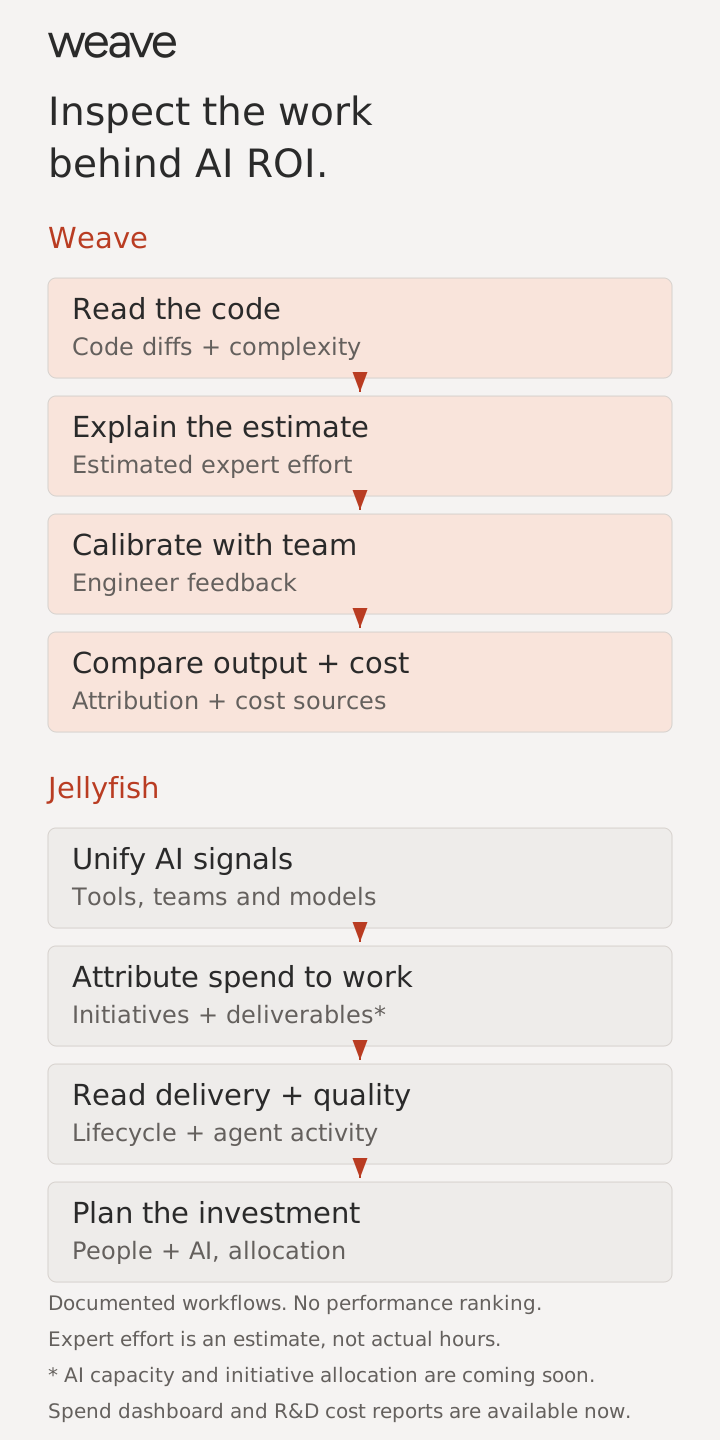
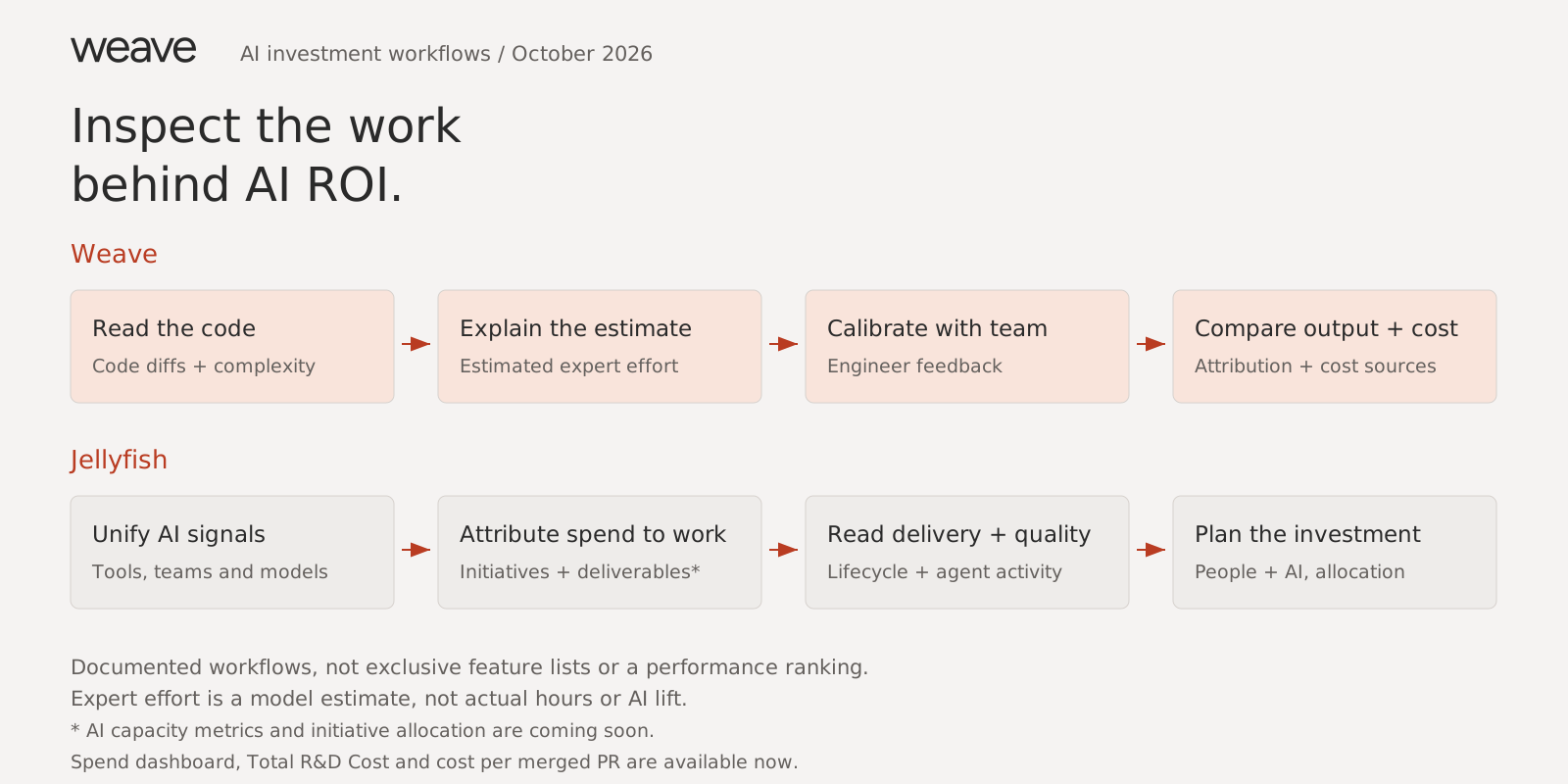
Weave gives you an output definition to inspect: estimated expert effort for the code changes in a pull request. Read the explanation, compare routine and complex changes, and calibrate estimates with engineers who know the work. Then investigate costs and attribution against that defined output population.
1391011Jellyfish
Jellyfish’s documented approach
Jellyfish joins AI usage and spend with SDLC signals, initiatives and investment context. Its current materials describe throughput, cost forecasts, spend-to-work attribution and agent activity. The October launch also announced headcount-normalized AI Capacity, but its Oct. 7 recap says AI capacity metrics and initiative-level AI spend allocation are coming soon. The recap lists the spend dashboard, Total R&D Cost and R&D cost per merged PR as available now. Ask about availability, the denominator, allocation rules and underlying work records.
1391011Choose Weave when an explained code-output estimate is central to the buying decision. It gives the budget discussion a code-level basis you can inspect. A documentation comparison does not establish that another vendor lacks a similar capability or that either method proves causal AI gains.
Why Weave
Build the decision from code, context and cost
Explain what the output represents
Inspect Silk 1’s reasoning for changes your engineers know well. Use complexity and cross-file context to discuss the estimate, and calibrate it with your team.
13In practice
Compare the decisions you need to make
Renew a coding assistant
Weave
Compare assisted output and total cost over a defined team and period. Inspect the explanation and attribution evidence before treating a change as an AI effect.
Jellyfish
Use tool comparison, token-cost and impact reports. Ask how spend maps to work and how mixed-tool users affect the comparison.
Evaluate autonomous agents
Weave
Read agent costs and output separately from human-driven AI work. Include accepted work, failures, rework and review load.
Jellyfish
Review human and agent activity in Metrics Explorer and lifecycle insights. Confirm connectors and the actual acceptance and quality measures.
Explain the engineering budget
Weave
Connect the output estimate and its reasoning to team and investment reporting. Use Wooly to investigate changes; validate salary assumptions and allocations.
Jellyfish
Review total R&D cost, spend-to-work attribution and selected finance modules. Confirm whether the quote includes the reports your finance team needs.
Choose for your workflow
When Jellyfish may fit your team
Include Jellyfish when broad SDLC analysis, developer experience, investment allocation or DevFinOps drive the purchase. Its current AI product also covers agent behavior, costs and work attribution. If the decision depends on an explained effort estimate for code changes, start your Weave evaluation there and compare the actual outputs each vendor demonstrates.
810121Try it on your own work
Run a focused pilot before switching
Keep the reporting boundary consistent
Choose a representative repository, team and period. Record identity mapping, included work, excluded files, permissions and history. Preserve your existing baseline.
Inspect the measures behind the charts
Bring a routine fix, a refactor and an AI-assisted change your engineers understand. In Weave, inspect the effort estimate and explanation. In both products, ask how the report defines output, attribution, quality and missing data.
Reconcile the total cost
Match invoices, subscription allocations and connected-tool costs. Include platform modules and any separate Router plan. Review rework, acceptance and delivery before broadening the rollout; a lower cost ratio alone does not establish business ROI.
A few more details
Frequently asked questions
Compare engineering intelligence
All comparisonsSee the work behind your AI investment
Bring a real pull request and a budget question. Inspect Weave’s output estimate, its explanation and the cost evidence alongside it.
Behind the comparison
Sources and comparison method
Published by Weave. Official product, pricing, methodology, release and event recap sources reviewed October 16, 2026, including Jellyfish’s October 7 release and availability recap. This is a documentation comparison, not an independent product trial. Descriptions explain documented workflows, not exclusive capabilities. No matched accuracy, savings or ROI benchmark was run. Confirm connector coverage and contracted modules in a trial.
- Weave Code Intelligence: Silk 1, explanations and calibration
- Weave Token Intelligence: attribution, cost sources and agents
- Weave AI ROI methodology: expert hours, coverage and limits
- Weave Engineering Intelligence: output and investment context
- Wooly: research grounded in engineering records
- Weave pricing: Starter, monthly Pro and Enterprise
- Weave Router: separately offered coding-agent routing
- Jellyfish AI Impact: adoption, delivery, quality and workflows
- Jellyfish AI Token Cost Management: throughput and allocation
- Jellyfish October 7, 2026 release: agents, spend-to-work attribution and R&D cost
- Jellyfish Oct. 7 recap: AI spend allocation and capacity metrics coming soon
- Jellyfish pricing: seat- and module-based quotes