Coding-agent evaluation · Sources checked
Evaluate coding-agent costs with Weave Router
Weave Router delivers Astra quality at about half the cost in published Codex-harness benchmarks. Use this guide to evaluate accepted work, full-session costs and a reversible rollout in the coding client you already use.
On this page
Weave Router 2.0 delivers Astra quality at about half the cost in its published coding-agent benchmarks. On Terminal-Bench 4.0, Router solved 62.1% of tasks versus GPT-6 Astra's 60.6%, at $5.22 versus $10.03 per trial. Mean agent time was 20.5 versus 44.1 minutes. The comparison used the same Codex harness and tasks.
Bring that decision into your own workflow: keep Claude Code or Codex, define the work you need accepted, and inspect the entire session's cost and result. This guide gives you a practical pilot template and a clear switch-back path.
Start with the published comparison
The Router 2.0 results report two attempts per task. Solved is pass@2: a task counts when at least one attempt passes. Cost and mean agent time are per trial.
Scroll horizontally if needed →
| Benchmark | System | Tasks solved (pass@2) | Cost per trial | Mean agent time per trial |
|---|---|---|---|---|
| Terminal-Bench 4.0 · 66 tasks | Weave Router | 62.1% | $5.22 | 20.5 min |
| Terminal-Bench 4.0 · 66 tasks | GPT-6 Astra | 60.6% | $10.03 | 44.1 min |
| Terminal-Bench 4.0 · 66 tasks | OpenRouter Auto | 25.0% | $5.52 | 36.0 min |
| SWE-Atlas Codebase QnA · 124 tasks | Weave Router | 62.1% | $2.31 | 6.8 min |
| SWE-Atlas Codebase QnA · 124 tasks | GPT-6 Astra | 66.1% | $5.04 | 16.7 min |
| SWE-Atlas Codebase QnA · 124 tasks | OpenRouter Auto | 54.0% | $1.49 | 5.7 min |
Router and Astra runs are paired. OpenRouter is a separate run within three days. Cost sources are Router catalog billing, direct-model vendor list prices and OpenRouter billing. The benchmark methodology documents the harness and scoring.
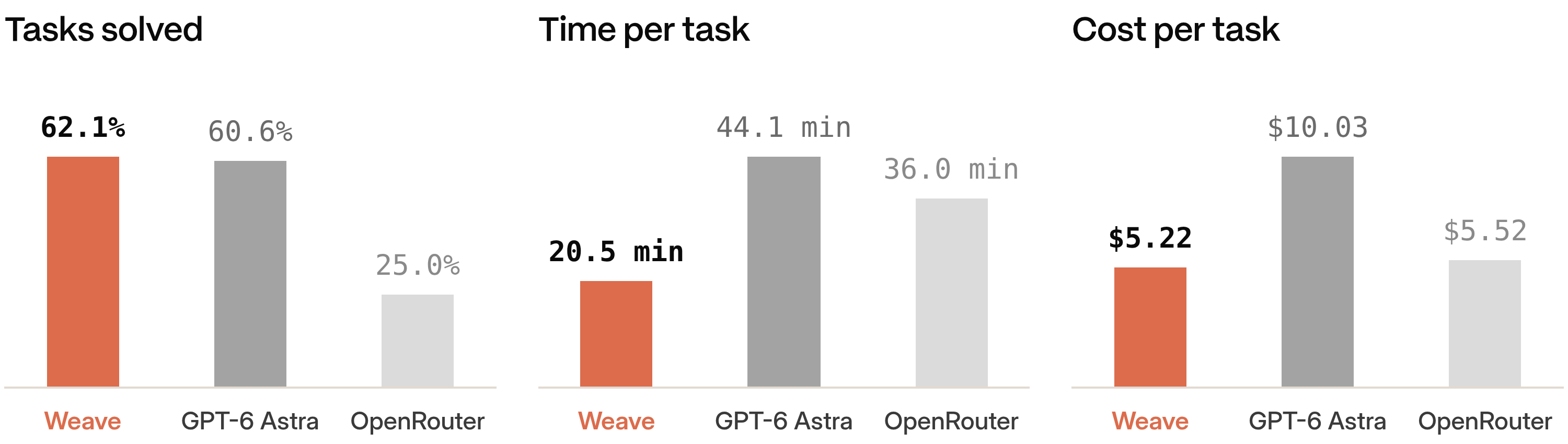
Terminal-Bench 4.0: pass@2 over 66 tasks; cost and mean agent time per trial.
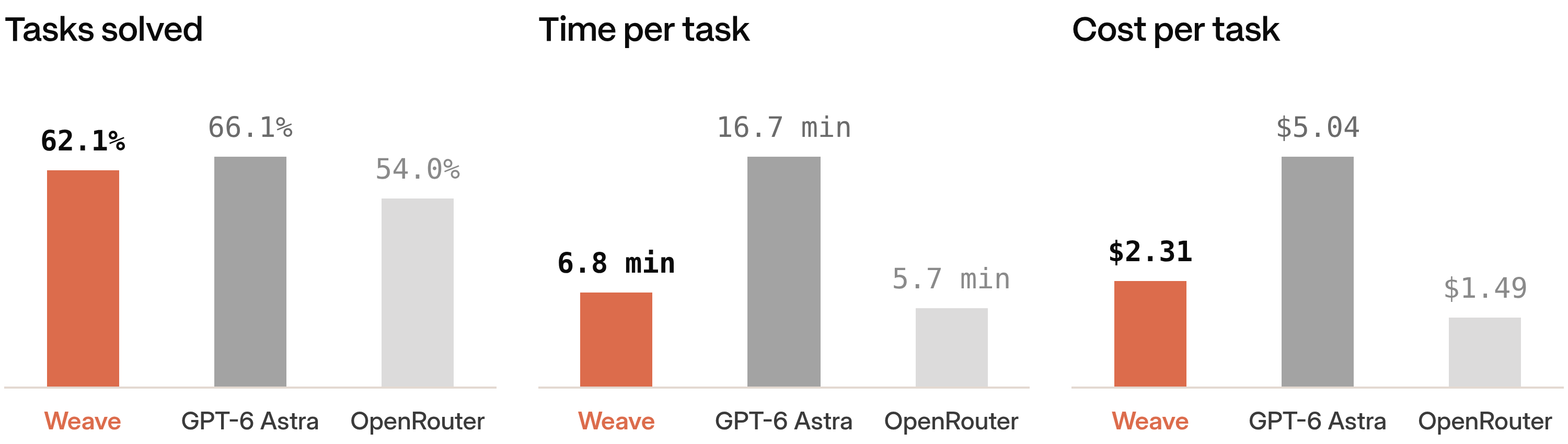
SWE-Atlas Codebase QnA: pass@2 over 124 tasks; cost and mean agent time per trial.
Evaluate the whole session
Weave's production evidence shows why session economics matter. During September 1–30, 2026, Router handled 1,624,315 requests across 52 installations and about 234,000 agent sessions. It rerouted 1,329,835 requests, reported as 82%. Routed traffic billed about 44% less than the originally requested models would have cost. 53% of input tokens were prompt-cache reads. See the production report.
Those repeated context reads are part of the workload. Switching models can require rebuilding a warm cache. Weave tracks cache state per provider and session, switching when expected savings exceed that rebuilding cost. Include cache reads, writes, retries and context-handling calls when reviewing a task's economics.
Keep the client. Inspect the work behind the bill.
Weave gives a coding-agent pilot three concrete advantages:
- Native workflow: configure Claude Code or Codex while keeping the client and repository workflow your engineers use.
- Action-level routing with session context: select models inside the task while accounting for the cache the session has built.
- Inspectable evidence: drill from a user into a session and requested/served-model pair, then inspect underlying model, provider, token and cost records through a read-only export.
The Router implementation is also available to inspect. Current releases from router-v0.2.24 onward use Apache-2.0.
Define the pilot before changing the endpoint
Choose real work your team understands, such as a bug fix with a regression test or a repository question with a checkable answer. Keep the client, starting revision and task requirements consistent across the comparison. Agree on acceptance criteria and review ownership before running it.
Scroll horizontally if needed →
| Decision | Record before the pilot |
|---|---|
| Work and quality bar | Tasks, repository revision, acceptance tests and reviewer |
| Comparison | Current model/provider, client/version and proposed Router setup |
| Economics | Account/plan, pricing date, billing basis and approved budget |
| Boundaries | Date window, timezone, cache starting conditions and stopping rule |
| Evidence | Session IDs, complete call records, task result and elapsed time |
Decide how to handle retries and incomplete tasks in advance. Keep failed work in the review. A task that needs another attempt still consumed time and resources.
Read the result alongside the cost
Open the Router dashboard or the Weave app's Router report. Filter by date, engineer or team, then drill into user → session → requested/decision-model pair. Claude Code's /router-session command gives the correlation ID.
For underlying records, use your existing authorized analytics owner and the read-only export. One NDJSON row is an upstream model call. Use request_id to identify related retries and keep their charges. Inspect served models/providers, token/cache counts, actual costs and outcome fields alongside the task's acceptance evidence.
Keep these distinctions in the review:
- Actual charges, API-rate valuation and fixed subscription fees: included usage can have zero marginal API charge while the subscription still has a price. A null cost is unknown.
- Complete coverage:
X-Weave-Has-More=truemeans a partial page. Preserve the window and schema;recorded_atis ingest time andrequested_atis event time. - Explicit comparator: September's requested-model comparison, dashboard savings against your configured comparison model, and raw actual charges are separate. The export has no precomputed savings column.
Record whole-task wall-clock time from the client or work record. Call latencies can overlap. Review task acceptance separately from API status.
Start small and keep switch-back ready
Follow the Claude Code or Codex setup guide. Choose user or project scope, record the previous provider, and run the documented status check. Reopen Claude Code after changes; Codex uses the new connection on its next run.
The documented off command disables routing while preserving its configuration. Match the original scope when switching back.
Expand when the work meets your quality bar, complete session costs support the decision, and the workflow fits. Keep the task evidence with the review so the next rollout decision starts from what your team actually completed.
Sources
Put Weave Router to work
Keep Claude Code or Codex, then review completed work and whole-session costs in the existing Router report.
Start with Router